By Homecrest Guide Editorial Team · September 28, 2026
Washington, DC has some of the highest home prices in the country, so the income needed to buy here is well above the national average. But «how much income do you need» has a different answer depending on the price range, your debts, your down payment and the loan type you use.
Quick answer: to comfortably afford a $400,000 condo in DC, most buyers need a gross household income of roughly $95,000 to $110,000. For a $600,000 home, expect to need around $145,000 to $165,000, and for a $800,000 home, roughly $190,000 to $215,000. These ranges assume a 10% down payment, a 30-year fixed loan and manageable existing debt; your exact number depends on your personal finances.
In this guide
- Income needed by home price, with full payment breakdowns
- How down payment size changes the income you need
- How debt affects the income required
- How loan type changes the math
- Ways to qualify for more home with the same income
- What lenders count as income
- FAQs
Income needed by home price in DC
These figures use a 30-year fixed rate of 6.5%, a 10% down payment, a 36% back-end DTI, and typical DC property tax, insurance and (where noted) condo fees. Rates and fees change, so treat these as a starting point and confirm with a lender.
$350,000 home (typical entry-level condo)
- Loan amount: about $315,000
- Principal and interest: about $1,990
- Property tax: about $248
- Insurance: about $50
- Condo fee: about $400
- PMI: about $130
- Total monthly payment: about $2,818
- Income needed (at 36% DTI, minimal other debt): about $94,000/year
$500,000 home (larger condo or small rowhouse)
- Loan amount: about $450,000
- Principal and interest: about $2,845
- Property tax: about $354
- Insurance: about $80
- Condo fee (if applicable): about $450
- PMI: about $190
- Total monthly payment: about $3,919
- Income needed: about $131,000/year
$650,000 home (rowhouse or townhouse, no condo fee)
- Loan amount: about $585,000
- Principal and interest: about $3,698
- Property tax: about $460
- Insurance: about $130
- PMI: about $195
- Total monthly payment: about $4,483
- Income needed: about $150,000/year
$850,000 home (larger rowhouse or detached home)
- Loan amount: about $765,000
- Principal and interest: about $4,835
- Property tax: about $602
- Insurance: about $170
- PMI (or none, with 20%+ down): about $190
- Total monthly payment: about $5,797
- Income needed: about $193,000/year
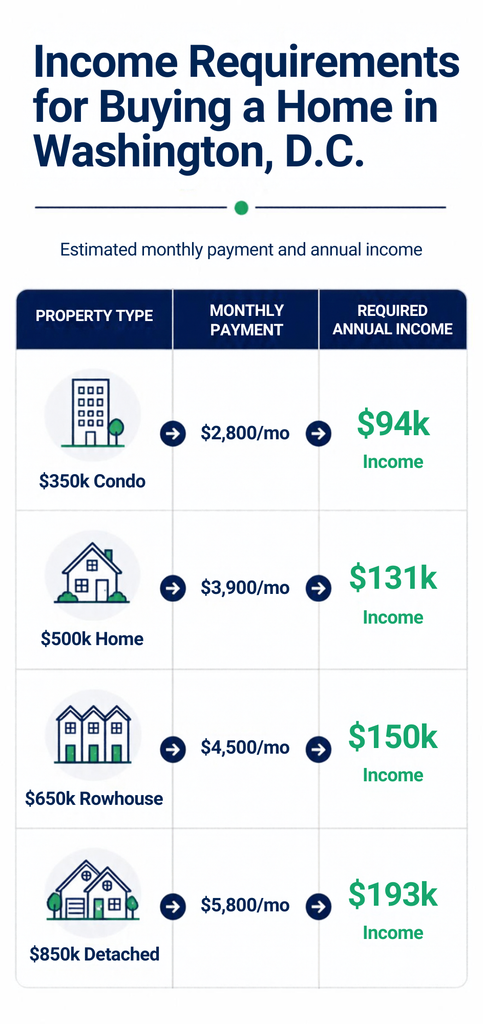
These numbers are illustrative and assume good credit, minimal other debt and current-ish rates. [Link: DC Mortgage Payment Calculator With Taxes and Insurance] to test your own scenario. [verify current rates, tax rate and typical insurance/condo fee figures before publishing]
How down payment size changes the income you need
A bigger down payment lowers your loan amount, your monthly payment and often your PMI, which directly lowers the income required.
Example on a $500,000 home:
- 5% down: loan of $475,000, payment around $4,150/month, income needed around $138,000
- 10% down: loan of $450,000, payment around $3,920/month, income needed around $131,000
- 20% down: loan of $400,000, payment around $3,400/month (no PMI), income needed around $113,000
Going from 5% to 20% down can lower the income you need by roughly $25,000 a year on a $500,000 home. This is one of the biggest levers buyers have, which is why down payment assistance programs matter so much in DC.
How existing debt changes the income you need
Lenders look at your total debt, not just the mortgage. The more you owe elsewhere, the more income you need to hit the same DTI.
Example on a $500,000 home, payment of about $3,920/month:
- No other debt: income needed at 36% DTI is about $131,000
- $500/month in other debt (car loan, student loans): income needed rises to about $147,000
- $1,000/month in other debt: income needed rises to about $164,000
Paying off a car loan or reducing credit card balances before applying can lower the income requirement by tens of thousands of dollars a year, which is often faster and cheaper than waiting to earn more. …which is often faster and cheaper than waiting to earn more. Learn more in our guide on Debt-to-Income Ratio for Mortgages: Limits and How to Improve It.
How loan type changes the math
- FHA loans allow a higher DTI in many cases (sometimes up to 50% with strong compensating factors), which can lower the income needed on paper, but they carry mortgage insurance for the life of most loans, adding to the monthly cost….adding to the monthly cost. You can review full eligibility rules in our guide to FHA Loan Requirements and Limits in Washington, DC.«
- VA loans for eligible veterans often use a residual income method instead of a strict DTI cutoff, and require no down payment, which can significantly reduce the income needed relative to a conventional loan.
- Conventional loans are stricter on DTI for most buyers but avoid ongoing FHA-style mortgage insurance once you reach 20% equity.
- Jumbo loans, needed for DC’s most expensive homes, usually require stronger income documentation, larger reserves and a lower DTI, effectively raising the income bar beyond the raw payment math.
Ways to qualify for more home with the same income
- Add a co-borrower. A spouse, partner or family member’s income can be combined to qualify for a larger loan, though their debts count too.
- Use a DC assistance program to reduce the down payment or closing costs you need to cover out of pocket, freeing up savings and sometimes improving your rate.
- Pay down existing debt before applying, especially high monthly payments like a car loan.
- Consider a condo with lower fees or a home without a condo/HOA fee, since fees count directly against your DTI.
- Shop multiple lenders, since DTI limits, overlays and program eligibility vary by lender even for the same loan type. [Link: Best Mortgage Lenders in Washington, DC: How to Compare Them]
- Ask about a rate buydown or points, which lower your monthly payment (and thus the income needed) in exchange for an upfront cost.
What counts as income for a mortgage
Lenders typically look at gross income before taxes, and generally want a stable two-year history in the same field. Common types include:
- W-2 salary and hourly wages
- Overtime, bonuses and commissions (usually averaged over two years)
- Self-employment income (based on tax returns, typically averaged over two years)
- Federal employment income, including some allowances
- Military base pay, housing allowance (BAH) and other qualifying military income
- Retirement, Social Security and disability income
- Rental income from an existing property, usually at a reduced percentage to account for vacancy and expenses
If your income is irregular (self-employment, contract work, tips), plan for extra documentation and talk to a lender early, since this can change your timeline more than your final number.
Next steps
- Use the payment examples above to estimate the income range for your target price.
- Get preapproved to see your real number based on your actual income and debts.
- If you’re short of the income needed, look at assistance programs, a co-borrower, or paying down debt before applying.
- Compare loan types, since the «income needed» can shift significantly between FHA, VA and conventional.
Frequently asked questions
What salary do you need to buy a house in DC? It depends heavily on price, down payment and debt, but as a rough guide: around $94,000 for a $350,000 condo, and around $150,000 for a $650,000 rowhouse, assuming a 10% down payment and manageable debt.
Can I buy a home in DC with a single income? Yes, though it usually means a smaller condo or more down payment, since a single income has to cover the full DTI on its own. Assistance programs and low-down-payment loans can help.
Does household income or individual income matter for a mortgage? Lenders qualify you based on the income of everyone on the loan application, not household income in general. Two applicants can combine incomes; a partner who isn’t on the loan generally can’t be counted.
How is income calculated if I’m self-employed? Most lenders average your net income (after business expenses) from the last two years of tax returns, not your gross revenue. This often results in a lower qualifying income than your bank statements might suggest. Speak with a lender early if this applies to you.
Do bonuses and overtime count toward mortgage income? Usually yes, if you have a consistent two-year history and your employer confirms it’s likely to continue. A single large bonus or new overtime pattern may not count fully.
Disclosure: This article is for educational purposes and isn’t financial advice. Rates, taxes, insurance, program rules and underwriting guidelines change; confirm current figures with a licensed lender before making decisions.