by 21newblood12 / septiembre 28, 2026
Your credit score doesn’t just decide whether you get approved. It decides your interest rate, your monthly payment and, in a high-cost market like Washington, DC, how much home you can actually afford. A 60-point difference in your score can mean tens of thousands of dollars over the life of the loan.
Quick answer: most lenders in DC require a minimum credit score of 580 for FHA loans, 620 for conventional loans, no official minimum for VA loans (though most lenders want 580–620), and usually 700+ for jumbo loans . Meeting the minimum gets you in the door; a higher score gets you a meaningfully better rate.
In this guide
- Minimum credit score by loan type
- How your score changes your interest rate
- Why «minimum» and «practical» scores are different
- Credit score ranges lenders actually see
- What hurts and helps your score before you apply
- How long it takes to raise your score
- FAQs
Minimum credit score by loan type in DC
FHA loans
- Official minimum: 580 for the low-down-payment option (3.5% down).
- 500 to 579 is sometimes allowed with a larger down payment (usually 10%), though many lenders don’t offer this in practice.
- FHA is popular with first-time buyers in DC because of its flexible credit rules, but it requires mortgage insurance for the life of most loans.
Conventional loans
º
- Typical minimum: 620.
- Buyers with scores in the 620s and 630s can qualify, but usually with a higher rate and more scrutiny on income and reserves.
- Below 620, most conventional lenders won’t approve the loan; FHA becomes the more realistic path.
VA loans
- The Department of Veterans Affairs does not set an official minimum score.
- In practice, most DC lenders require 580 to 620 for VA loans, since they still need to sell the loan to investors with their own rules.
- VA loans often have competitive rates even at moderate scores, and no down payment is required for eligible veterans.
Jumbo loans
- DC’s high home prices mean many buyers need a loan above the conforming limit [verify current DC-area conforming loan limit].
- Jumbo lenders are stricter: expect a minimum of 680 to 700, and often 720+ for the best rates, along with larger reserves and a lower DTI.
Loans for federal employees and special programs
- Some lender programs aimed at federal employees or first responders may use standard FHA or conventional score minimums, with added benefits like reduced fees rather than lower score requirements. [Link: Loans for Federal Employees Buying in DC: What Options Exist?]
| Loan type | Official/typical minimum | Realistic score for approval without extra conditions |
|---|---|---|
| FHA | 580 (500–579 with 10% down) | 620+ |
| Conventional | 620 | 680+ |
| VA | No official minimum | 580–620 |
| Jumbo | Varies by lender | 700+ |
Figures are typical ranges reported by lenders; confirm current requirements, as they can change with market conditions.
Minimum score vs the score you actually want
Qualifying is not the same as qualifying well. Lenders use pricing tiers: as your score drops, your rate goes up, even if you technically meet the minimum.
Example (illustrative, not a rate quote):
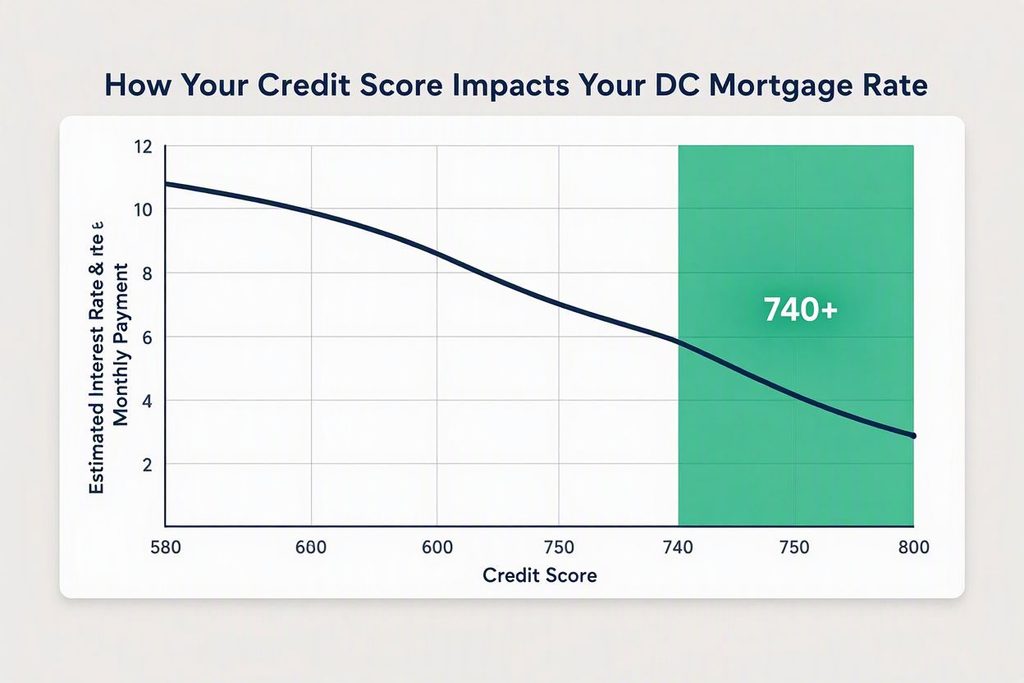
Example (Estimates based on Fannie Mae LLPA benchmarks):
- Buyer A (Credit Score 760+): Estimated Interest Rate 6.25% (Monthly Payment: ~$2,770)
- Buyer B (Credit Score 680-699): Estimated Interest Rate 6.75% (Monthly Payment: ~$2,918)
- Buyer C (Credit Score 620-639): Estimated Interest Rate 7.375% (Monthly Payment: ~$3,107)
*Calculation based on a $450,000 fixed-rate loan amount. Difference between Buyer A and Buyer C is over $330/month ($118,800 over the lifetime of a 30-year loan).
On a $450,000 loan, the difference between Buyer A and Buyer C could be $300 or more per month, and tens of thousands of dollars over 30 years. In an expensive market like DC, that gap can be the difference between qualifying for the home you want and having to look at a lower price range.
Credit score ranges lenders look at
Lenders typically pull scores from all three bureaus (Equifax, Experian, TransUnion) and use the middle score for a single applicant, or the lower of the two middle scores for co-borrowers.
| Range | What it generally means for a mortgage |
|---|---|
| 760+ | Best available rates and terms |
| 700–759 | Strong pricing, few conditions |
| 660–699 | Approvable, moderate rate increase |
| 620–659 | Conventional is possible but costlier; FHA often better |
| 580–619 | FHA is usually the realistic path |
| Below 580 | Very limited options; focus on credit repair first |
What hurts your score before you apply
- Late payments, even by a few days, can stay on your report for years.
- High credit card balances relative to your limit (utilization) lower your score quickly.
- New credit accounts or hard inquiries opened shortly before applying (financing furniture, a new car, opening store cards).
- Closing old credit cards, which can shorten your credit history and raise utilization.
- Co-signing a loan for someone else, which adds to your DTI and risk profile even if you’re not the primary borrower.
What helps your score before you apply
- Pay down credit card balances below 30% of the limit, ideally below 10%, in the months before applying.
- Pay every bill on time, including small recurring charges that can go to collections unnoticed.
- Don’t open or close accounts in the 3 to 6 months before applying for a mortgage.
- Dispute errors on your credit report; incorrect late payments or accounts that aren’t yours are common and fixable.
- Keep old accounts open, even with a zero balance, to preserve your credit history length.
- Ask about rapid rescore with your lender if you’ve recently paid down debt; it can update your score in days instead of a full billing cycle.
How long it takes to raise your score
- Paying down credit cards: often shows results in 30 to 60 days, once the new balance is reported.
- Fixing a credit report error: typically 30 to 45 days through the dispute process, faster with rapid rescore.
- Recovering from a late payment: the impact fades over 12 to 24 months if you stay current afterward.
- Recovering from a major event (collections, bankruptcy, foreclosure): can take 2 to 7 years, though FHA and VA loans allow buyers back in sooner than conventional loans in many cases.
If you’re several months away from buying, this is the highest-leverage window to improve your score before you apply. If you’re buying soon, focus on the fastest wins: balances and errors.
Should you wait to improve your score or buy now?
There’s no universal answer, but consider:
- If a 30–60 day effort could move you to the next pricing tier, it’s often worth the wait, especially on a large DC loan.
- If home prices or rates are rising faster than your score-related savings, buying sooner with a higher rate (and refinancing later) may make more sense. [Link: When Does Refinancing Make Sense? Break-Even Calculator]
- If you’re near the FHA minimum, a housing counselor or loan officer can often tell you within one conversation whether a short delay meaningfully changes your terms.
Next steps
- Pull your credit reports and check for errors before you apply.
- Ask a lender to run scenarios at your current score and at a realistic improved score.
- Compare loan types based on your score, not just the interest rate advertised. [Link: FHA vs Conventional Loan in DC: Which Costs Less?]
- If your score is below 580, talk to a HUD-approved housing counselor in DC before applying.
Frequently asked questions
What credit score do I need to buy a house in DC? Most buyers need at least 580 for FHA, 620 for conventional, and around 580–620 in practice for VA loans. Jumbo loans usually require 700 or higher. Your exact rate and terms depend on your full financial picture, not the score alone.
Can I get a mortgage in DC with a 500 credit score? It’s difficult. FHA technically allows scores from 500–579 with a 10% down payment, but few lenders offer this in practice. Most buyers in this range benefit more from a few months of credit repair before applying.
Does a higher credit score always mean a better rate? Generally yes, up to a point. Rates typically flatten out somewhere in the mid-700s to 800s, meaning the jump from 620 to 700 usually matters more than the jump from 760 to 800.
Which loan type is easiest to qualify for with a lower score? FHA loans generally have the most flexible credit requirements, followed by VA loans for eligible veterans. Conventional and jumbo loans are stricter.
Will checking my credit score hurt it? Checking your own score (a soft inquiry) does not affect it. A lender’s official credit pull (a hard inquiry) can cause a small, temporary dip, but multiple mortgage inquiries within a short window (usually 14–45 days) are typically counted as one for scoring purposes.
Disclosure: This article is for educational purposes and isn’t financial advice. Credit score requirements and mortgage guidelines change; confirm current minimums with a licensed lender before making decisions.